
By Paul Noeldner
Friends of Urban Nature
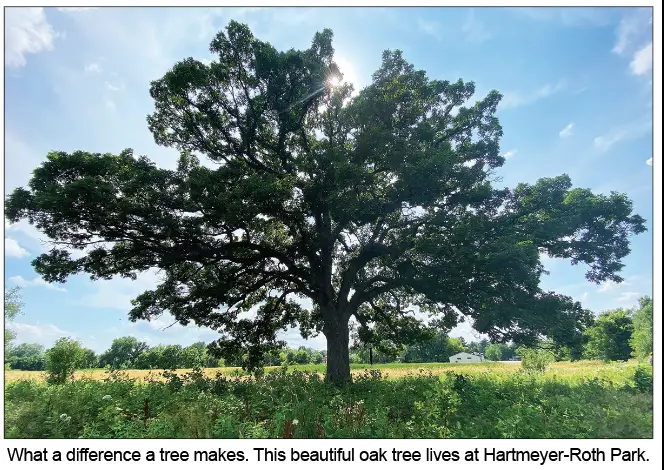
Trees cool cities by shading concrete and buildings to avoid trapping heat (the urban heat dome) and by transpiring hundreds of gallons of water on hot days like giant natural air conditioners, which also helps dry out saturated ground and reduce basement flooding. After recent hailstorms, roofing inspectors and insurance adjusters noted that having large tree canopies helped protect roofs from hail damage.
Trees help reduce Climate Change-related extreme heat spells by as much as 10 degrees or more. An individual mature tree can reduce annual air conditioning costs by 100–400 kWh, which adds up to over six million dollars annually for Madison’s 125,000 households.
The urban tree canopy currently helps shade and cool about 23% of Madison’s land surface. In an important tree study done in Madison, researchers took temperature readings every five meters throughout the city. Results showed the most substantial temperature drops occur when a neighborhood has 40% or greater tree canopy cover. Less dense canopies yield much smaller results.
Currently, wealthier neighborhoods in Madison have significantly more trees than lower-income areas. City Urban Forestry has set a long-term goal of a 40% tree canopy citywide, as recommended by the American Forests Association. However, the Emerald Ash Borer and urban development that failed to prioritize saving trees and natural areas have caused significant loss of mature trees in Madison. It takes dozens of new tree plantings and 20–40 years to replace the cooling and environmental benefits of mature trees.
Environmental and social justice go hand in hand. Saving mature trees in all neighborhoods and distributing new tree planting to be more equitable can help to not only lower temperatures but also bring mental and physical health benefits to the community. This also helps save native woodland wildflowers, insects, birds, wood frogs and other wildlife that depend on urban trees and provide kids and adults with access to nearby nature in all neighborhoods.
Businesses, campuses and homeowners can help by saving older trees as long as possible. Planting native understory helps trees live longer. Individuals can encourage Madison alders to adopt a Natural Areas Ordinance and city policies that set a priority on preserving mature trees, saving remaining natural areas, and planting more native trees in parks and private property. These actions will help preserve and expand Madison’s beautiful tree canopy to 40% in all neighborhoods.
